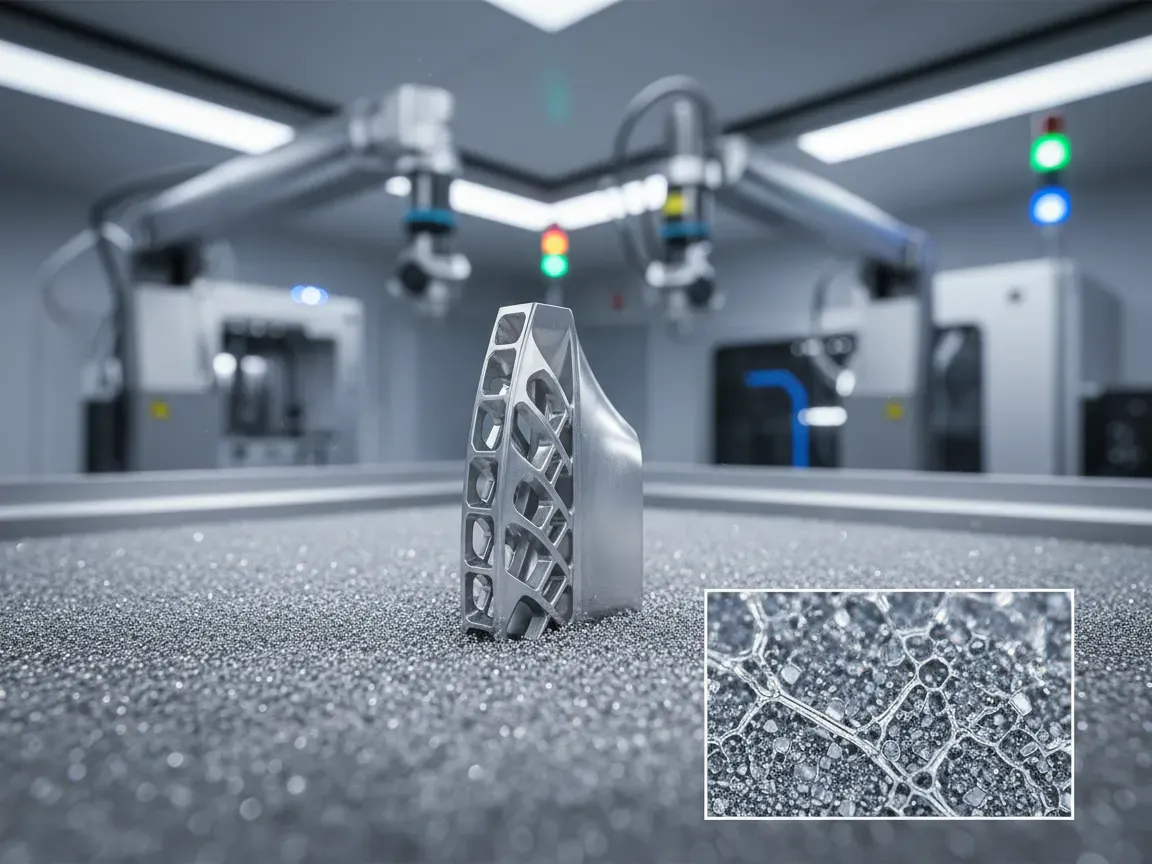
Modern engineering frequently collides with the physical boundaries of conventional fabrication. Casting, forging, and subtractive machining have propelled industrial progress for centuries, yet they struggle to meet the strict demands of next-generation performance. Today, hardware development requires components that are lighter, stronger, and capable of operating under punishing physical conditions without adding unnecessary mass. As engineers strive to optimize efficiency down to fractions of a gram, granular material science has emerged as the foundation of critical design breakthroughs.
Powder-based production represents a departure from traditional metallurgical constraints. Instead of cutting intricate parts out of solid ingots or pouring liquid metal into molds with high thermal variation, engineers build components grain by grain. This transition delivers unmatched control over internal microstructures, custom material densities, and consolidated geometries. By unlocking previously impossible architectures, fine-grain materials are actively reshaping key high-tech sectors where failure is never an option.
What makes powder-based engineering critical for modern hardware?
At its core, the transformation begins at the microscopic scale. Solid billets of steel, titanium, or nickel-base alloys possess crystal structures determined by large-scale heating and mechanical forming. In contrast, powdered particles can be engineered with consistent spherical shapes, precise chemical distributions, and controlled grain boundaries. These powders undergo thermal consolidation where heat and pressure fuse the grains below their melting points, preserving advanced mechanical properties that conventional liquid casting destroys.
Industrial applications heavily depend on powder metallurgy to produce near-net-shape parts that bypass multi-step machining operations. Because traditional subtractive cutting can waste up to eighty percent of an expensive alloy block, powder consolidation offers a significantly higher material yield. Minimizing scrap directly cuts manufacturing expenses while lowering the energy footprint of hardware fabrication.
Equally important is the capacity to combine materials that refuse to alloy naturally in a liquid state. Metal matrix composites, ceramic-metal blends, and functionally graded materials can be formulated as powders and sintered into single homogeneous components. Designers no longer face compromises between surface hardness and core elasticity. They can tailor hardware characteristics zone by zone to survive specific operational stresses.
How electric vehicles utilize sintered parts to extend range?
Automotive propulsion has fundamentally shifted from internal combustion engines to electric drives, bringing weight efficiency to the forefront. For electric vehicles, every extra pound of curb weight directly degrades battery range and acceleration. Engineers utilize powder-consolidated soft magnetic composites and lightweight structural components to minimize mass without surrendering the stiffness required for chassis safety and driveline reliability.
Powder techniques excel at yielding complex planetary gears, transmission synchronizer rings, and motor stator cores. Electric motors operate at rotational speeds far exceeding traditional combustion setups, generating unique thermal loads and high electromagnetic alternating frequencies. Soft magnetic powders insulated with thin dielectric coatings drastically reduce eddy current losses within motor cores. This microstructural optimization ensures that electrical energy translates cleanly into kinetic torque rather than parasitic heat, directly increasing driving distance per charge.
Furthermore, compact cooling plates for EV battery packs leverage advanced sintering to integrate thin-walled internal channels. These tortuous pathways ensure optimal thermal transfer across dense battery cells during fast charging. Producing such channels via traditional brazing or extrusion often creates leak-prone joints. Sintered monolithic enclosures prevent fluid leaks, safeguard sensitive battery chemistry, and keep pack architectures remarkably slim.
Why aerospace engineering relies on advanced metal powders for extreme conditions?
Aerospace applications leave zero room for structural compromise. Turbines, combustion chambers, and rocket nozzles endure thousands of degrees of heat alongside rapid pressure cycling. Historically, manufacturing complex turbine blades with internal cooling channels required intricate ceramic core casting, a process prone to internal voids and structural variations. Modern aerospace manufacturing increasingly turns to high-grade superalloy powders, such as nickel-chromium and titanium aluminide alloys, to construct high-temperature components with continuous internal cooling passages.
Material conservation represents an equally powerful incentive in flight engineering. Aerospace alloys, especially titanium and specialized cobalt formulations, are notoriously difficult to cut and consume enormous amounts of energy during CNC machining. Moving toward selective powder consolidation drastically lowers the buy-to-fly ratio, transforming what was once a ten-to-one scrap challenge into an efficient additive cycle. Hardware can fly with organic load-bearing ribs designed via topology optimization, shedding mass while carrying identical or improved structural loads.
Thermal protection systems on reusable launch vehicles also rely on sintered porous metals to manage extreme re-entry temperatures. Controlled transpiration cooling allows minuscule amounts of coolant gas to flow through porous metal skins, blanketing the spacecraft surface against violent atmospheric friction. Conventional solid plates simply melt under these hypersonic thermal loads, demonstrating how micro-engineered porosity acts as a shield against physical destruction.
Perfecting human integration through porous medical implants
Outside of propulsion and orbital flight, powder consolidation is fundamentally transforming orthopedic medicine. Traditional smooth metal joint replacements present an inherent mechanical mismatch with living human tissue. Cortical bone is dynamic, elastic, and constantly remodeling itself in response to physical stress. Solid titanium implants are far stiffer than human bone, frequently leading to stress shielding, a condition where the metal absorbs all mechanical stress, causing surrounding bone to weaken and deteriorate.
Powder-based technologies resolve this physiological mismatch by creating porous structures that match the stiffness and porosity of natural trabecular bone. Controlled sintering of medical-grade titanium and tantalum powders creates connected pore networks that encourage bone cells to migrate directly into the implant matrix. This natural osseointegration eliminates the reliance on toxic chemical adhesives or artificial bone cements, anchoring the hardware permanently within the skeleton.
Surgeons can deploy custom spinal cages, hip cups, and cranial plates that integrate micro-porous interior scaffolds within durable outer frames. The ability to vary porosity gradients throughout a single component guarantees that bone integration takes place smoothly at the contact interface while the structural core withstands long-term walking, running, and heavy load impacts. The result is a profound drop in secondary revision surgeries, delivering better outcomes and faster recovery times for patients.
What lies ahead for advanced powder materials across high-tech sectors?
The evolution of powder engineering is moving toward hyper-customization and multi-material integration. Researchers are now developing smart powders with embedded nanosensors capable of reporting internal component stress, temperature spikes, and fatigue damage before microscopic fissures lead to catastrophic hardware failure. As computational material modeling advances, engineers can simulate granular compaction down to individual contact points, predicting post-sintering physical behavior with pinpoint accuracy.
This continuous expansion across electric mobility, aerospace platforms, and biomechanical devices proves that macroscopic hardware innovation begins at the microscopic level. Embracing powder consolidation enables developers to bypass traditional manufacturing limits and design components guided purely by physics and physiological needs rather than tool access. Understanding and adopting these methods will separate the industry leaders from the legacy builders as high-performance engineering moves forward into an efficiency-driven future.